I’ve watched a good business card lose a deal. Not because of the design — because the ink smudged the moment a thumb touched it.
Here’s the thing nobody tells you about professional printing services in Kenya. The gap between a great printer and a cheap one is rarely visible on the quote. It shows up three days later, when your 500 brochures arrive with the wrong colour, or your banners show up the morning of the event with a spelling error baked into twelve square metres of vinyl.
In 2026, print is far from dead. It’s just held to a higher standard, because everything digital is free and everything physical has to earn its place in someone’s hand.
So the question isn’t whether to print. It’s who you trust with it.
I’ve spent years around print buyers — the ones who never complain, and the ones who learn the hard way.
This is the checklist I wish someone had handed me first. Real prices, real turnaround times, real red flags. Let’s get into it.
What “Professional Printing Services in Kenya” Actually Means in 2026
Professional printing services in Kenya are a managed process, not a machine. That process runs from file preparation and colour management to proofing, production, finishing and delivery. The machine is the smallest part of the story.
This matters because the word printing gets used for two very different businesses. A copy shop has a multifunction printer and a counter. A print house has calibrated equipment, a paper sample book, a finishing department and someone who will tell you your file is wrong before you pay for 2,000 wrong copies.
That second part is the bit people underestimate. I’ve seen buyers spend a week chasing a printer who won’t pick up the phone. That silence costs more than the job.
When you buy professional printing, you’re really buying three things.
- Colour accuracy — the red on your proof is the red on your box, every time.
- Material honesty — the 300gsm card you were quoted is actually 300gsm, not 250gsm quietly substituted.
- A human who answers — before the deposit, and especially after.
Everything else is finishing. And finishing is where a decent print house separates itself from a hurried one.
Spot UV that makes a logo catch the light. Matte lamination that feels expensive in the hand. Die-cutting, foil stamping, spiral binding, perfect binding, embossing.
These are the touches that make a document feel like it came from a company that has its act together.
Here’s a quick reality check on the Kenyan market, because it’s crowded. You’ve got CBD copy shops doing fast, cheap, small runs. You’ve got established commercial printing firms built for corporate volumes.
And you’ve got online print stores with published prices and nationwide delivery, which is a newer development and a genuinely good one for anyone outside Nairobi.
The last group is worth paying attention to if you’re ordering from Mombasa, Kisumu or Eldoret. Published prices mean you can budget without a phone call. Nationwide delivery means the printer’s location stops being your problem.
Look, I’m not going to pretend all three tiers are the same quality. They’re not.
But “professional” isn’t a location or a price point. It’s whether the process is managed or improvised.
Digital, Offset or Large Format? Matching the Method to the Job
Most buyers never ask which method their job will run on. That’s a mistake, because the method decides your price, your lead time and your colour consistency.
Digital printing is the workhorse for short runs. It prints straight from a file with no plates, so setup is basically free and turnaround is fast.
It’s perfect for 50 to 500 pieces, for personalised jobs like name badges or variable-data certificates, and for anything you need this week. Where it hurts is volume. Past a few hundred pieces, the per-unit cost stops falling and just sits there.
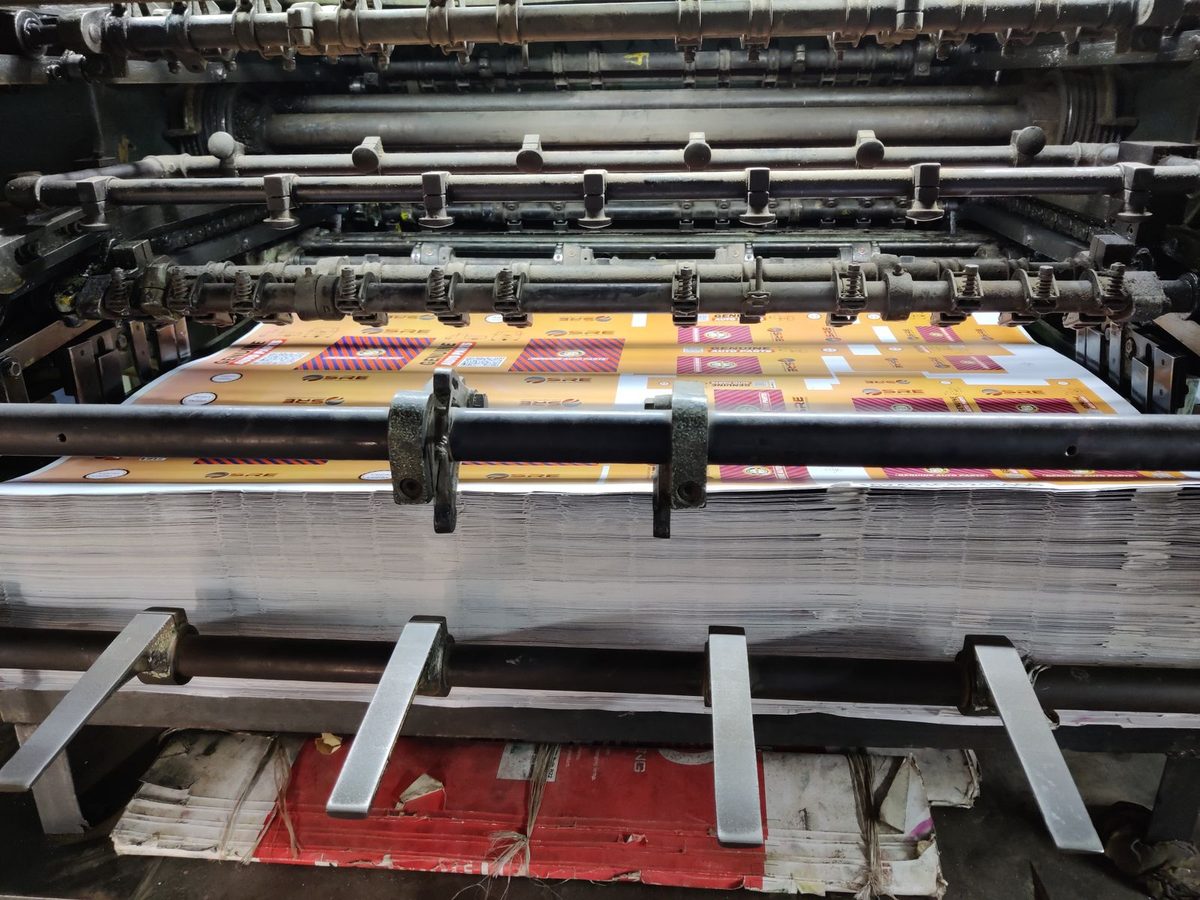
Offset litho is the opposite trade. You pay a setup cost up front — plates, make-ready, wash-up — and then the per-unit price drops hard as quantity climbs.
For straightforward jobs like letterheads, flyers and brochures, the break-even against digital usually lands somewhere in the 500 to 1,000 range. Above that, offset wins on both price and colour consistency across the run. Below it, you’re paying for plates you didn’t need.
Large format is a different animal entirely. Banners, backdrops, window graphics, wall murals, vehicle branding, floor graphics.
Here the material matters more than the machine, and the decisions are about surviving outdoors. Mesh vinyl for wind. Backlit material for lightboxes. One-way vision film so people can see out but not in.
Frosted film for meeting-room privacy that still lets daylight through.
One thing I’d push you on: laminate your outdoor work. Nairobi sun is unforgiving, and so is a rainy season that arrives when it feels like it. Unlaminated vinyl fades and scratches.
Laminated costs a little more and lasts a season longer. That’s not a sales pitch, that’s just maths.
Here’s the short version as a decision table.
| Job type | Best method | Typical quantity | Realistic lead time |
|---|---|---|---|
| Business cards, flyers, brochures | Digital (offset above ~500) | 50–500 | 1–3 days |
| Letterheads, receipt books, NCR | Offset | 500–5,000 | 3–5 days |
| Banners, backdrops, wall graphics | Large format | 1–20 | 3–7 days incl. install |
| Branded merch, tees, mugs | Sublimation / DTF / screen | 10–500 | 5–10 days |
| Spot UV, foil, embossed cards | Digital + finishing | 100–1,000 | 4–7 days |
Specialty finishing deserves its own mention. Spot UV gives you a glossy raised logo on a matte card, and it’s the single cheapest way to make a business card feel premium.
Soft-touch lamination makes paper feel like suede, which sounds gimmicky until you hold one. Embossing and foil stamping are for the jobs where a certificate or an invitation needs to feel ceremonial.
None of these are necessary. All of them are noticeable.
What Print Actually Costs in Kenya in 2026
Let’s talk money, because this is where most print advice goes quiet and vague.
First, kill the price-per-unit habit. The number on the quote is rarely the number you pay. Total job cost includes artwork fixes, proofing, delivery, and the reprint you didn’t plan for.
A quote of KSh 18 per flyer with a KSh 4,000 artwork fee is worse than KSh 22 with clean file handling included.
Second, know what normal looks like. Here are real anchors from the Marsha Digital store as of 2026 — letterheads from KSh 45, flyers from KSh 20, brochures from KSh 60, spot UV business cards from KSh 65, spiral binding from KSh 200, and wedding cards from KSh 140.
On the branding side, teardrop banners run about KSh 12,500, X-banner stands around KSh 4,500, branded mugs from KSh 850 and custom notebooks from KSh 370.
Those numbers are useful in a very specific way. They let you sanity-check a quote in ten seconds instead of three phone calls. If someone quotes you KSh 120 for a plain flyer, ask what’s different about it.
Now, volume discounts. Some are real, some are theatre.
A genuine discount reflects the fact that setup cost gets spread across more units, which is exactly why offset gets cheap at scale. A fake discount is a “was KSh 30, now KSh 20” banner that never expires.
Ask for the price at two quantities — say 500 and 2,000 — and watch how the curve behaves. If the per-unit price barely moves, there’s no real volume logic behind it.
Then there are the hidden costs nobody quotes you.
- Artwork repair — fixing a low-res logo or rebuilding a file, billed hourly or as a flat fee.
- Rush fees — same-day and next-day jobs carry a premium, and rightly so.
- Courier outside Nairobi — nationwide delivery is a real cost, and it varies by weight and county.
- Reprints from bad files — the most expensive line item in Kenyan print, and the most avoidable.
Here’s how I’d compare three quotes. Line them up on the same page and check five things: unit price at your actual quantity, material and weight specified in grams, whether a proof is included, delivery cost to your address, and what happens if the colour is wrong.
That last one is the whole ballgame.
A cheap quote that refuses responsibility for its own output isn’t cheap. It’s a deposit on a problem.
And a note on timing, because prices move. Treat every figure in this article as a 2026 snapshot. Confirm current rates when you order — a good printer will show you their price list without flinching.
Artwork Files, Proofs and Turnaround: How to Avoid the Reprint
I’ll be blunt: most reprints are the customer’s file, not the printer’s machine. That’s not blame, it’s good news. It means you can prevent almost all of it yourself.
The file specs that prevent roughly nine out of ten problems are boringly consistent. CMYK, not RGB. 300 DPI at final size. Three millimetres of bleed on every edge.
Fonts outlined or embedded. Export as PDF/X-4. If you send that, you’ve already beaten most of the market.
Why CMYK matters so much: your screen glows, paper reflects. A vibrant RGB green will look dull and slightly sad once it’s ink on card. Convert before you send, not after you’re disappointed.
And please don’t trust a soft proof on your phone. Your screen is calibrated for Netflix, not for Pantone. If colour is tight — brand colours, skin tones, product photography — ask for a hard-copy proof.
It costs a fraction of a reprint, and it’s the only proof that tells the truth.
Do that maths out loud once. A hard proof on a brochure run might cost a few hundred shillings. A reprint of 500 brochures at KSh 60 each is KSh 30,000.
The proof is not the expense here.
Turnaround times, realistically:
- Same-day digital — business cards, flyers, small stationery runs, if the file is clean and the queue is kind.
- 2–5 working days — offset stationery, receipt books, NCR sets, perfect-bound booklets.
- 3–7 working days — large format, banners and signage, longer if installation is involved.
- 5–10 working days — branded merchandise, embroidery, custom packaging.
Add time for approvals. A job that sits in your inbox for two days waiting for sign-off has a seven-day turnaround, no matter what the printer promised.
Here’s the checklist I’d tape to the file before sending.
- Bleed: 3mm on all sides.
- Resolution: 300 DPI at final print size.
- Colour mode: CMYK, not RGB.
- Fonts: outlined or embedded.
- Format: print-ready PDF or PDF/X-4.
- Images: linked and supplied, not just placed.
- Totals and dates: proofread twice, out loud.
- Approval: written sign-off on the final proof.
Print that list once and keep it. It will save you more money than any discount you’ll negotiate.
How to Vet a Printing Company in Nairobi (and the Red Flags)
Choosing a printer is a procurement decision, so treat it like one. Ask questions, and notice how they’re answered.
Seven questions worth asking before you pay a deposit.
- Can I see a sample of this exact material? Not a portfolio on a screen. A physical sample in the weight and finish you’re buying.
- Is a proof included, and is it hard copy or digital?
- What’s your actual turnaround in working days, from approved proof?
- Who is responsible if the colour is off or the file prints wrong?
- What’s the delivery cost to my address, and who carries the risk in transit?
- Can you issue a proper ETR invoice with your KRA PIN?
- What’s your deposit policy, and what happens if I cancel mid-run?
That last cluster matters more than people expect. Corporates, NGOs and schools run on paperwork — LPOs, procurement approvals, VAT invoices. A printer who can’t produce clean documentation creates a problem your finance team will remember.
Now the red flags. No physical address, or an address that turns out to be a shared desk with no production floor. No proof stage at all, just “we’ll print it as it is.”
Prices quoted before anyone has looked at your file. A sample book you’re not allowed to touch. Deposit demanded in full, up front, on a first order.
And the one I’d weight heaviest: reluctance to put commitments in writing. Anything agreed on a phone call about a job worth tens of thousands of shillings should live in a message or an email.
Delivery and installation carry their own risk, so clarify it. If a banner tears in transit, whose problem is it? If a wall graphic bubbles two weeks after installation, who comes back?
Get the answer before, not after.
A good printer will not be offended by any of this. They’ll be relieved, because clear buyers make clean jobs.

Beyond Paper — Where Print Meets Brand Environment
The most interesting shift in Kenyan printing right now isn’t in documents. It’s in spaces.
Walk into a well-branded office in Westlands and count the print touchpoints. Reception signage. A wall graphic behind the desk. Frosted film on the glass with the logo cut out of it.
Door graphics, floor vinyl in the corridor, safety signage that’s actually designed rather than downloaded. None of it is expensive individually. Together it’s the difference between a company that looks established and one that looks like it moved in last month.
Wall branding is the standout. Large-format wall murals and cut vinyl graphics turn a blank reception wall into a brand statement, and they photograph well — which matters in 2026, because every visitor is holding a camera.
Glass frosting does double duty: privacy for meeting rooms, plus a place for your logo to live. Window graphics and one-way vision film let you brand a shopfront without blocking the view out.
Then there’s merchandise, which has quietly become a retention tool rather than a giveaway. Branded mugs, notebooks, tees, tote bags, aprons, lanyards, water bottles.
The quality signal here is the print method. Sublimation on mugs survives the dishwasher. Cheap transfers peel in a month.
On apparel, DTF and screen printing hold up through repeated washing while heat transfers on dark fabric crack. Ask what method is being used, and ask to feel a sample.
Event branding deserves to be planned as one kit rather than four separate orders. Backdrop, pull-up banners, media wall, selfie frame, table runners, all matching.
When they arrive as a set, the event looks designed. When they arrive in four slightly different shades of your brand colour, it looks like a committee did the ordering.
Which brings up the real risk in all of this: drift. Paper says one thing, merchandise says another, the wall says a third.
Fix it with three simple rules. Lock your brand colours as CMYK and Pantone values, not hex codes. Define a minimum logo clear space and stick to it everywhere.
Keep a short material palette — two or three finishes you always use, so everything feels related.
Then sequence the rollout. Start with the things customers touch most: business cards, letterheads, the reception wall. Then documents and packaging.
Then merch and event kit. Doing it in one coherent push costs less than four rushed ones, and it looks like one brand instead of four.
Conclusion
Four things separate professional printing from cheap printing: a real proof stage, honest materials, a turnaround you can plan around, and a human who picks up the phone when something goes sideways.
That’s the whole checklist, honestly. Everything else is detail.
So reframe the decision. You’re not shopping for the lowest price per unit. You’re buying the absence of a crisis.
No smudged cards at the expo, no misspelt banner at the launch, no reprint invoice three days before your deadline.
Here’s what I’d do next.
Send Marsha Digital your file and your quantity and ask for a written quote. You’ll get a unit price at your actual volume, a materials spec in grams, delivery cost to your address, and a proof before anything goes to press.
Order straight from the store if you already know what you want, and enjoy the fact that the price is on the page instead of behind a phone call.
If it’s urgent — an event this week, a launch that moved — message on WhatsApp rather than filling in a form. Urgent jobs need a human, not a queue.
And if you’re outside Nairobi, order anyway. Nationwide delivery means the printer’s postcode stopped being your problem somewhere around 2024.
Print is still the most permanent thing most businesses make. Get it right, and it works for you in every hand it lands in.