Introduction
“You never get a second chance at a first impression.” I’ve heard that line a hundred times, and I used to roll my eyes at it. Then I watched a client hand over a flimsy, curling card at a networking event and see the other person’s face drop.
That card cost him a lead. It also cost him a lot of pride.
Here’s the thing most Kenyan businesses get wrong in 2026: they spend money on adverts, then hand people a cheap card that falls apart in a week. It makes no sense to me.
I’ve walked hundreds of print jobs through the door. I’ve seen smart entrepreneurs lose deals over a typo, and I’ve seen a simple card open a door that no Facebook ad could.
So let me save you the trial and error. In this guide I’ll show you what business cards printing Kenya costs this year, which paper and finishes actually matter, how to design a card people keep, and where to order without getting ripped off.
Read it once and you’ll know exactly what to ask for. Let’s get into it.

What Determines the Cost of Business Cards Printing in Kenya in 2026?
Here’s the question I get asked more than any other: “How much does business cards printing in Kenya actually cost?” My honest answer always makes people pause.
The price is not one number. It’s five different decisions stacked on top of each other.
That surprises folks. They think a business card is just a business card.
It isn’t. The same shop can quote you KSh 900 or KSh 9,000 for what looks like the same product.
The difference is always hiding in the details below. Let me walk you through each one the way I’d explain it to a client standing at my counter.
1. Paper weight (GSM).
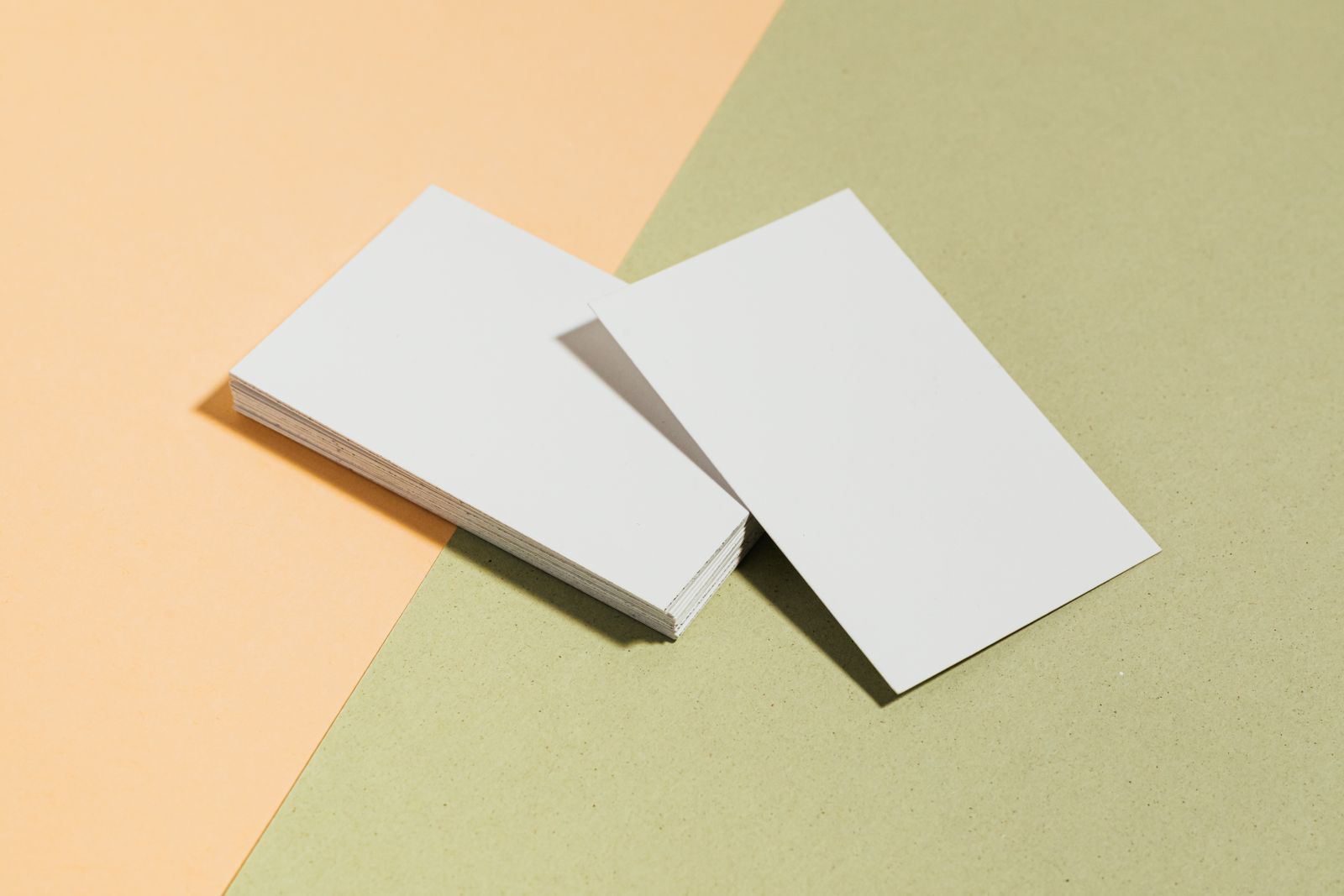
GSM stands for grams per square metre. It’s just a fancy way of saying how thick the card is.
A standard 300gsm card feels firm and professional. Push up to 400gsm and it feels substantial in the hand.
At 600gsm you’re holding something closer to cardboard, and people notice. Thicker stock costs more per sheet. That’s simple math.
But here’s what I tell every small business owner: don’t jump to the heaviest paper just to look expensive. A 350gsm card with a clean design beats a 600gsm card with a messy logo every single time.
2. Quantity.
This is where the price per unit drops fast. Ordering 100 business cards in Kenya will never match the per-card price of ordering 1,000.
The setup work is basically the same whether you print 100 cards or 1,000, so the printer spreads that effort across more units. That’s why bulk pricing looks so much better on paper.
Quick example. If a shop quotes KSh 45 per card at 100 pieces, that same shop might quote you closer to KSh 15–20 per card at 1,000 pieces.
Buy the run you’ll actually use. Cards you never hand out are not a bargain, no matter how cheap they looked per unit.
3. Finish upgrades.
Plain matte lamination is usually the base. Gloss lamination costs a little more.
Spot UV, rounded corners, foil stamping and embossing each add a step — and a step means money.
I’ve talked clients out of fancy finishes more than once. If you’re a plumber or a boda rider, a clean double-sided card with your WhatsApp number is perfect.
If you’re pitching investors or luxury clients, that spot UV logo on a dark matte card is worth every shilling. Match the finish to the room you walk into.
4. Design costs.
Some printers include free design. Some charge separately.
Neither is automatically better, so don’t let the word “free” do your thinking for you.
Free design usually means a template with your name dropped in. That’s fine for a market stall.
If you have a brand logo, brand colours and a real identity to protect, pay for proper artwork prep. Just confirm you get the final design file afterwards.
Nothing annoys me more than a business held hostage over a logo file. Always ask for the source file before you pay.
5. Delivery.
Nairobi customers can often pick up same day or next day. If you’re in Mombasa, Kisumu, Nakuru or Eldoret, county delivery adds cost and a day or two of time.
Ask about delivery before you pay, not after. Nationwide delivery across all 47 counties is common in 2026, but the fee and the timeline vary wildly between shops.
So what does business cards printing Kenya really cost? Here’s a fair ballpark. For a standard 300–350gsm, double-sided, matte-laminated card in a sensible quantity, expect somewhere from KSh 15 to KSh 60 per card in 2026, with bulk orders pushing lower.
A quote far under that usually means thinner stock or a hidden setup fee. Something has to give somewhere.
One more warning. If a price looks too good to be true, it usually is.
I’ve seen “cheap” quotes that quietly drop the GSM, print single-sided instead of double-sided, or skip lamination entirely. Ask three shops for quotes and compare them line by line.
Quick checklist — the five things that move your price:
- GSM (paper thickness): 300gsm is standard, 400gsm feels premium, 600gsm is luxury — and pricier.
- Quantity: more cards = lower cost per card, but only buy what you’ll actually hand out.
- Finish: matte is base; spot UV, foil and rounded corners all add cost.
- Design: free template vs custom artwork — always confirm you get the source file.
- Delivery: Nairobi is fastest and cheapest; upcounty adds fees and days.
Get those five answers in writing before you send a single shilling. Do that, and you’ll never overpay for business card printing in Kenya again.
Standard Business Card Sizes and Paper Types in Kenya
Let’s start with the number that settles half the arguments I have: 85mm × 55mm. That’s the standard business card size in Kenya, and it matches the international ISO 7810 ID-1 format — the same size as your ATM card, only smaller.
Why does that matter? Because every wallet, card holder and receipt book drawer in this country is built around that shape.
If you print something unusual, your card will be the one people leave behind. I learned that the hard way when a client insisted on a trendy square card.
Beautiful design, and nobody could fit it anywhere.
Stick to 85mm × 55mm unless you have a very good reason not to. The other sizes you’ll see — square cards, mini cards, folded cards — work for creatives and event invitations. For everyday networking, standard wins.
Now the fun part: paper.
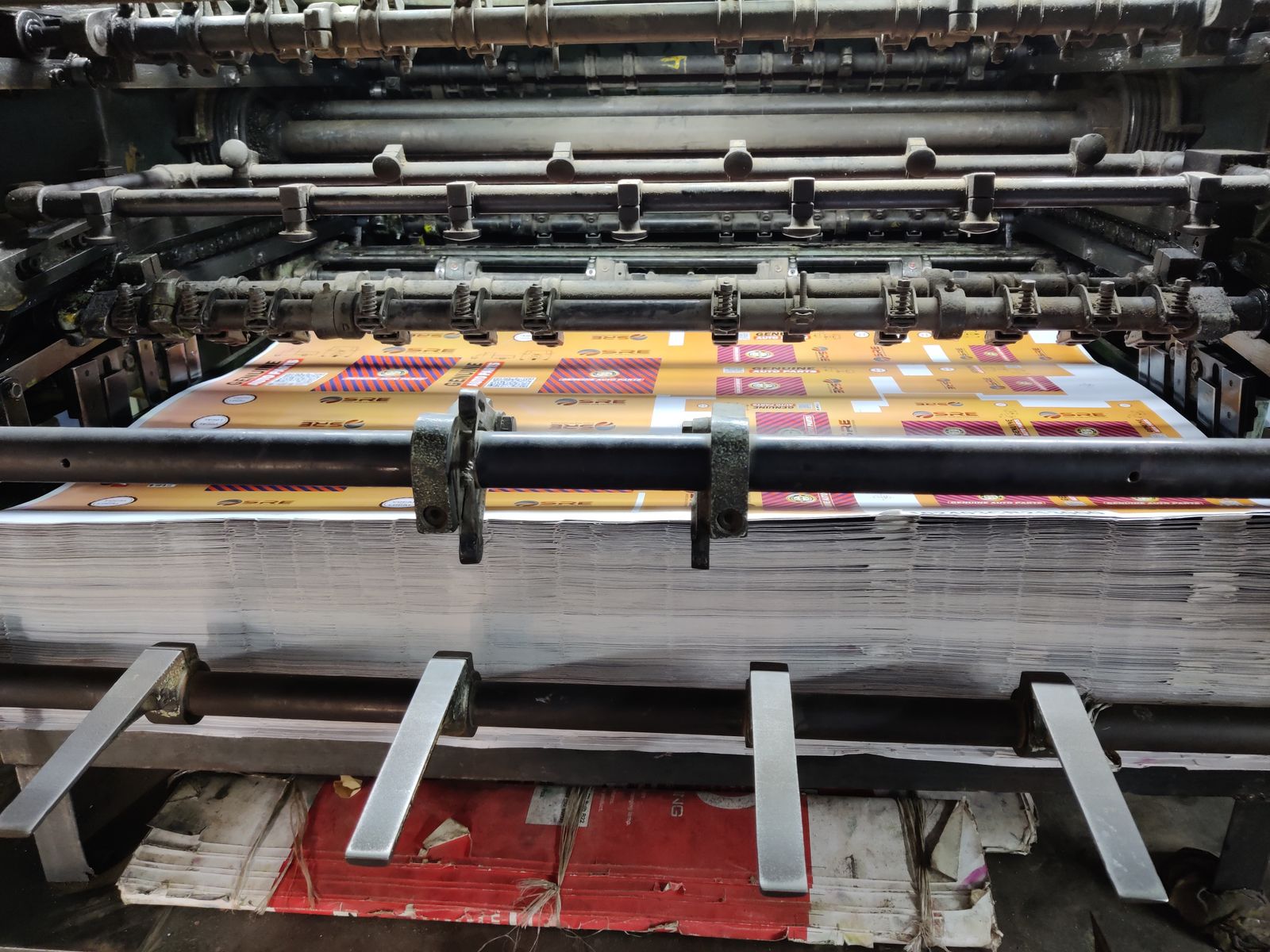
Coated vs uncoated. Coated paper has a thin layer on top that seals the surface. Ink sits crisply on it, colours look punchy, and photos stay sharp.
Uncoated paper has no seal, so the ink sinks in a little. It feels warm and tactile, and it’s easy to write on with a pen.
That last point is underrated. If people will scribble notes on your card, uncoated is smarter than glossy.
GSM, in plain English. GSM is paper thickness. A standard business card runs 300gsm to 350gsm.
Go to 400gsm and it feels premium in the hand. At 600gsm you’re basically holding a mini billboard.
Thin cards under 250gsm feel cheap and bend in a pocket. I refuse to print them for business clients, and you should be suspicious when someone quotes a price that assumes them.
Matte vs gloss — the everyday difference. Matte lamination gives a soft, velvety surface that doesn’t glare under office lights. It hides fingerprints and photographs beautifully.
Gloss lamination shines and makes colours pop, but it shows every smudge. On a card you handle twenty times a day, that matters.
My rule: matte for most businesses, gloss only when the artwork needs that extra shine.
Which paper for which job — the quick version:
- Professional services (law, finance, consulting): 350gsm matte, clean type, dark logo.
- Creatives and studios: 400gsm uncoated or soft-touch, bold design.
- Trades and field work: 400gsm with gloss lamination, so it survives dirty hands.
- Events and giveaways: 300gsm, ordered in bulk to keep costs down.
- Luxury brands: 600gsm with spot UV or foil — heavy, quiet, memorable.
One Kenyan detail nobody tells you: our humidity is real. Humid air curls cheap, uncoated stock fast. A coated or laminated card holds flat through a Nairobi rainy season, so that lamination is not just vanity.
Measure twice, quote once. Confirm the size, the GSM and the finish in writing before you approve anything.
Standard Finishes and Design Features That Make a Card Stand Out
A finish is the final treatment a printer puts on your card after the ink dries. Sounds small. It changes everything about how a card feels in someone’s hand.
The most common one is matte lamination — a thin film pressed over the card that gives it a smooth, non-shiny surface. It protects the ink from scuffs and makes the whole card feel modern.
Gloss lamination is the shiny cousin. Colours look richer and blacks look deeper, but the card reflects light and catches fingerprints. I use it when a client’s artwork is photographic or very colourful.
Then there’s soft-touch lamination, which is exactly what it sounds like. The card feels almost like velvet.
It costs a bit more, but watch someone’s face when they pick one up. They always rub it between their fingers.
Spot UV is my favourite upgrade, and I’m clearly not alone — it’s one of our most requested finishes in Nairobi. Spot UV is a raised, glossy varnish applied only to specific areas, like your logo or a pattern.
On a matte black card, that glossy logo catches the light while everything else stays flat. It looks expensive because it is precise.
Foil stamping, embossing and debossing are the luxury tier. Foil presses a metallic layer — gold, silver, copper — onto the card.
Embossing raises part of the design so you can feel the ridge with your thumb. These say law firms, hotels, banks, weddings.
Rounded corners are the small change with an outsized effect. A card with sharp corners eventually frays and dog-ears in a pocket.
Rounded corners stay neat, feel friendlier, and cost almost nothing extra. If your budget allows one upgrade and you don’t want flash, pick this one.
Single-sided vs double-sided: always double-sided if you can. Front for identity, back for details.
Here’s the cheat sheet I hand clients:
- Law, finance, insurance: matte lamination, restrained type, no gimmicks.
- Restaurants and cafés: gloss or uncoated with a menu QR code.
- Creatives and designers: soft-touch with spot UV or foil.
- Events and promotions: gloss, bulk quantity, rounded corners.
- Construction and trades: 400gsm gloss laminated — it has to survive a glove box.
Design mistakes I keep seeing in 2026: three fonts fighting each other, a logo too small to recognise, low-contrast text that vanishes in dim light, and QR codes printed too tiny to scan. One clear font, one strong logo, one obvious action.
Whatever finish you choose, ask for a physical proof before the full run. You cannot judge lamination from a screen.
How to Design a Business Card That People Actually Keep (2026)
Design is where good printing budgets go to die. I’ve seen gorgeous 600gsm cards tossed because the phone number was wrong. I’ve also seen plain cards kept for years because they were genuinely useful.
So let’s design for keeping, not for showing off.
The must-haves go on the front: your name, your role, your phone number, your email, and your website. That’s the core, and it should be readable without squinting.
The thing most Kenyan businesses forget is a WhatsApp line. Everyone here lives on WhatsApp.
Put the number with a clear label — “WhatsApp orders” or “Chat on WhatsApp” — and you’ve removed one whole step between meeting someone and getting their money. I’d put it before the email address, honestly.
Font size matters more than font choice. If your contact details drop below about 7pt, they blur in print.
I aim for 8pt minimum on details and 10–12pt for the name. Light, thin fonts are trendy on screens and a disaster on paper, especially in grey or light colours.
CMYK vs RGB — the colour trap. Your screen glows in RGB. Printers lay ink in CMYK.
That bold blue on your monitor can print flat and greyish if nobody converts it. Ask your printer to proof the colours, or better, send artwork already in CMYK.
Logos need 300 DPI. DPI means dots per inch — how much detail is packed into the image.
A logo lifted from a website is usually 72 DPI, which prints fuzzy and unprofessional. Ask for the original vector file (AI, EPS, PDF or SVG) and your logo stays razor sharp at any size.
Bleed, trim and safe margin. Bleed is the extra 3mm of artwork that runs past the cut line.
Without it, a slightly off cut leaves a white strip along the edge. The safe margin is the opposite: keep all text at least 3–4mm inside the trim so nothing gets sliced off.
QR codes in 2026 are worth adding if they lead somewhere useful — a WhatsApp chat, your M-Pesa till details, a portfolio, or a Google Maps pin. Make it at least 2cm square, keep it high-contrast, and scan it with your own phone before printing.
Pre-flight checklist for your designer:
- CMYK colour mode, not RGB
- Images at 300 DPI or higher
- 3mm bleed on all edges
- Text inside the safe margin (3–4mm from trim)
- Font size of at least 8pt for details
- Phone and WhatsApp number proofread twice
- QR code tested on two different phones
- Final file saved as a print-ready PDF
Run that list before you approve the proof and you’ll catch 95% of printing disasters before they cost you a cent.
Where to Get Business Cards Printing in Kenya: Online vs. Local Print Shops
You’ve got your design ready. Now the question: where do you actually order?
There are two honest answers in Kenya, and each has a real trade-off. I’ve been on both sides of this, so let me lay it out plainly.
Option one: the walk-in local print shop. You go in, you see paper samples, you talk to a human, and sometimes you walk out with cards the same afternoon.
The upside is tangible — you can feel the difference between 300gsm and 400gsm before paying. If your job is urgent, local wins outright.
The downside is consistency. Prices often depend on who’s at the counter that day.
Finishes like spot UV or foil may not be available in-house, which means your job gets outsourced anyway — with a markup and a longer wait.
Option two: an online print shop. You upload your file, choose your specs, pay by M-Pesa, and the cards arrive at your door.
Pricing is usually transparent and quantity-based, which makes comparing quotes easy. Delivery across all 47 counties is standard in 2026, and many shops offer same-day rush in Nairobi.
The trade-off: you can’t touch the stock first, and you’re trusting a digital proof. Good shops send a PDF proof and won’t print without your approval. If a shop skips that step, walk away.
What to ask before you pay — regardless of which route you take:
- Will I see a proof before printing, and do I have to approve it in writing?
- What’s your reprint policy if there’s an error?
- What’s the exact turnaround, including delivery?
- Do you accept M-Pesa, and will I get a receipt?
- What GSM is actually included in this price?
That last question catches more cheap quotes than any other. “KSh 12 per card” means nothing until someone tells you the paper weight.
Delivery timelines. Nairobi usually gets same-day or next-day. Mombasa, Kisumu, Nakuru and Eldoret typically run one to three days after production.
Always count from the day your proof is approved, not the day you ordered. That’s where most misunderstandings start.
Red flags to skip immediately: no physical address, no reviews anywhere, prices far below the market, no proof process, and a phone number that only ever answers with “send the design, we’ll handle it.”
A simple comparison:
- Local shop: fastest, feel the paper, prices may vary, fewer premium finishes.
- Online shop: transparent pricing, more finishes, doorstep delivery, no paper preview.
My honest advice? Shortlist three providers, request identical quotes, and compare them line by line.
I’d do it myself if I were you. The ten minutes it takes usually saves you money and a reprint.
Common Mistakes to Avoid When Printing Business Cards in Kenya
Let me save you some pain. Every mistake below is one I’ve watched a real customer make, and most of them are cheap to avoid.
Mistake one: ordering 5,000 cards before testing 100. This is the big one.
New businesses love the bulk discount, then change their phone number, logo or job title three months later. Suddenly you have a box of wrong cards.
Order a small first run. Once you’ve handed them out and nothing needs changing, buy the big batch.
Mistake two: printing in RGB. I covered this earlier, but it costs people money, so it deserves its own mention. Screen colours and print colours are different systems.
If nobody converts your file, your brand blue can come back looking grey. Always ask for a CMYK proof.
Mistake three: tiny fonts and thin type. Your contact details at 6pt might look elegant on screen.
In print, especially in light grey, they turn into a smudge. If a 60-year-old client can’t read your number without glasses, the card has failed.
Mistake four: skipping the digital proof. Proofing takes five minutes.
Without it you’re gambling the whole run on a file you never checked. I’ve seen jobs printed with a client’s old email domain — caught on the proof, fixed before printing, disaster avoided.
Mistake five: choosing the cheapest quote without checking the GSM. A KSh 12 card and a KSh 30 card can look identical in the quote.
One is 250gsm and curls in a week. The other is 350gsm laminated and lasts a year. Always compare like with like.
Mistake six: reprinting everything after a rebrand. Smart businesses keep a small old-stock order for transition, then switch.
There’s no rule saying your whole company needs new cards on the same day. In 2026, with prices rising, printing smaller and more often is the savvy move.
Mistake seven: not tracking where cards come from. Write a tiny code on the back, or use a different QR link per batch.
Then when a client calls, you know exactly which networking event produced them. Data beats guessing, even at this small scale.
Your final pre-order checklist:
- Small first run, not 5,000
- Artwork in CMYK at 300 DPI
- Details at 8pt or larger
- Written proof approved before printing
- GSM confirmed in the quote
- Delivery timeline confirmed from proof approval
- M-Pesa receipt requested
Print that list, tick every box, and your cards will do their job — which is opening doors, not sitting in a drawer.
Conclusion
Let’s pull it all together. Business cards printing Kenya does not have to be a guessing game. Business cards printing in Kenya in 2026 comes down to five cost drivers: paper weight, quantity, finish, design and delivery.
Standard size is 85mm × 55mm, 300–400gsm is the sweet spot, and matte lamination covers most professional needs. Save spot UV and foil for moments that deserve it.
Design for keeping, not bragging: big enough text, a WhatsApp line, a working QR code, and artwork in CMYK at 300 DPI. Then order from a shop that shows you a proof, quotes the GSM openly, and puts the turnaround in writing.
That is the standard any business cards printing Kenya provider should meet. Do those things and your card stops being waste. It becomes the cheapest sales rep you’ll ever hire.
Ready to print? Order your business cards with Marsha Digital — quality printing from KSh 45, Spot UV finishes from KSh 65, fast turnaround and nationwide delivery across Kenya. WhatsApp us today for a free quote on your next card run.