If you are choosing a banner for a shop front, a conference or an exhibition stand in Kenya, the decision usually comes down to two formats: the roll-up banner and the teardrop flag. They cost roughly the same to produce, they both pack down into a bag, and they both get your logo to eye level. What separates them is not price — it is how much floor space you have, whether you are indoors, and whether people will be walking past the stand or stopping at it.
This guide compares the two honestly, then covers the smaller formats people usually confuse with them.
The short answer
| If your situation is… | Print this | Why |
|---|---|---|
| Indoor conference, reception desk, exhibition booth with a back wall | Roll-up banner | Flat face, reads straight-on, hides nothing behind it, retracts for transport |
| Outdoor entrance, roadside, church grounds, launch on grass | Teardrop flag | Tall, visible over heads and cars, moves in wind, weighted base holds on uneven ground |
| A queue, a doorway, a five-second read | X-banner | Cheapest to produce, lightest, no mechanism to break |
| A big photograph or brand wall behind a speaker | Media wall or backdrop | Wide format is the point; the stand is secondary |
How a roll-up banner actually works
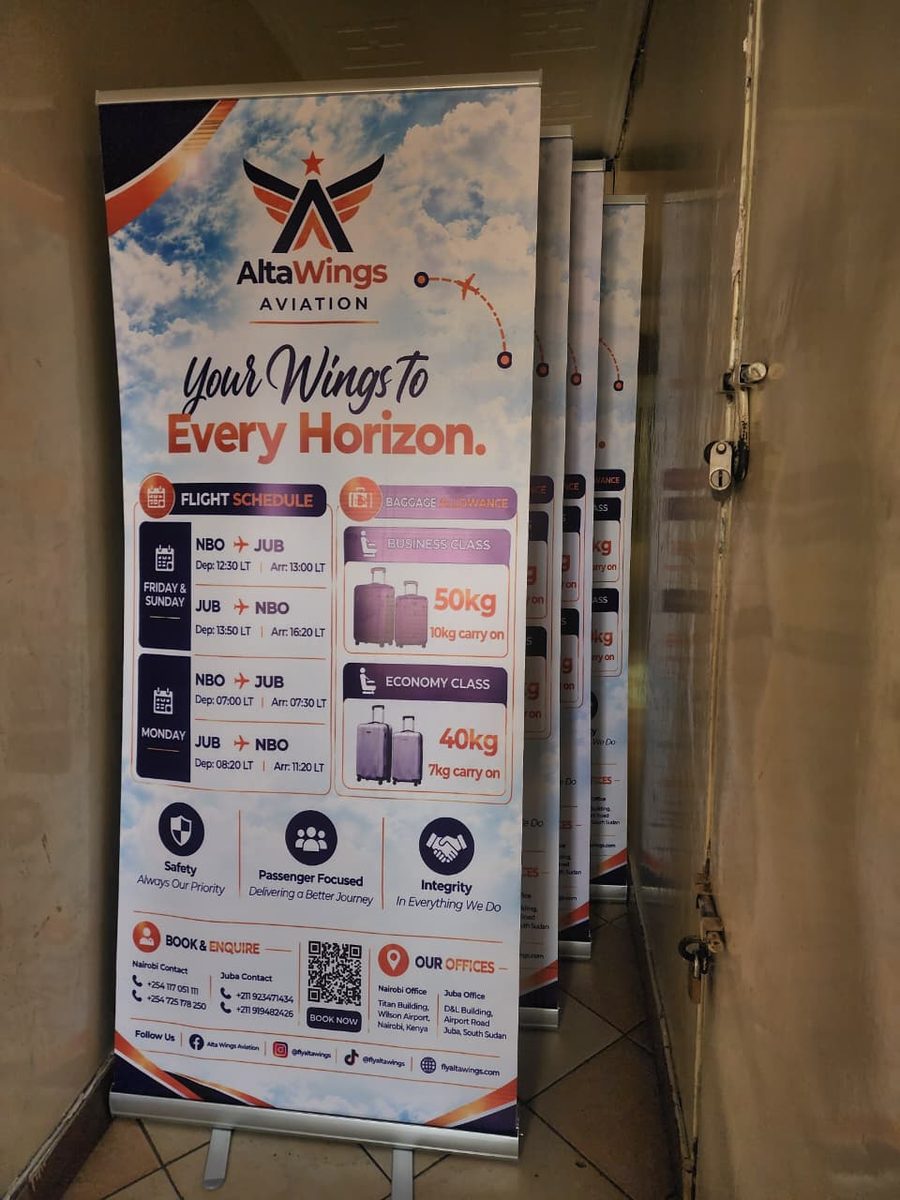
A roll-up — also called a retractable banner — is a printed panel attached to a spring mechanism inside an aluminium base. You pull the graphic up, hook it onto a pole, and the whole thing is standing in under a minute. When the event ends, it retracts into the base and goes into a carry bag.
The consequence of that mechanism is a detail most artwork never accounts for: the bottom of the graphic sits behind the base, so roughly the first 8–10 cm of the design is hidden when the banner is up. If your designer puts the website address or a logo at the very bottom of the file, it disappears. Keep the important content above that line.
Standard sizes are 80 × 200 cm and 85 × 200 cm, with 100 × 200 cm and 120 × 200 cm for wider stands. The 80 cm version fits through a normal doorway and into a car boot; the 120 cm version makes a much better impression but needs two hands and a wider space.
Where it wins: anything where someone reads from a metre or two away — pricing, a service list, a QR code, an offer. The flat face means no distortion and no glare curve, and because it is only 1.6 m wide at most, it slots into tight booth layouts.
Where it loses: outdoors in wind. A retractable unit is a sail on a light base, and a gust will lay it flat. It is also a poor choice when the floor behind it is visible, since the back of the unit is a bare aluminium foot.
How a teardrop flag works
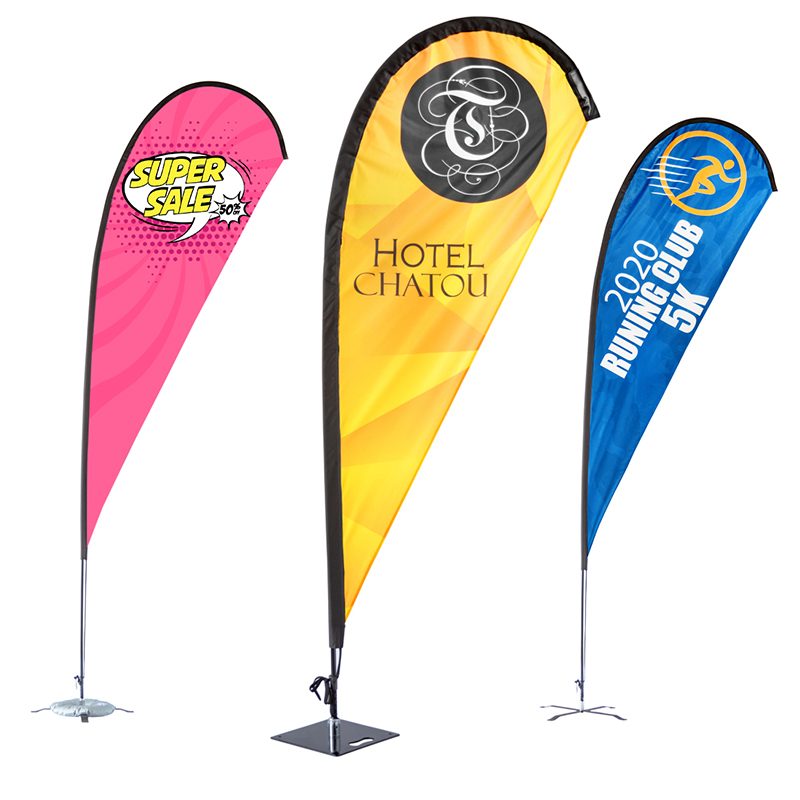
A teardrop flag — a feather flag, in some catalogues — is a curved fabric panel stretched over a pole that flexes in the wind, mounted on a ground spike, a cross base with a water weight, or a drive-on plate for a car. The shape is tall and narrow: commonly 3 m, 3.5 m and 5 m high, on a base roughly 60 cm across.
Because the panel is a single piece of fabric printed on both sides, the back of the flag is a mirror image of the front. Text on the reverse reads backwards. If both sides must be legible, that has to be handled in artwork — either duplicated panels or a design that does not depend on reading direction.
Where it wins: being seen from a distance and at an angle. A 5 m flag on a roadside or at the gate of an event is visible above parked cars and crowds, which is exactly the job a 2 m roll-up cannot do. The flexible pole also survives wind that would destroy a rigid frame.
Where it loses: close reading. Curved fabric distorts type, so a teardrop is a signpost, not a price list. It also needs more footprint than people expect — the base plus guy lines take roughly a square metre — and on hard paving you need a weighted base rather than a spike.
The formats people confuse with these two
X-banner
A printed panel on a folding fibreglass X-frame. Cheapest of the lot, lightest, and the frame can fail at the joints if it is repeatedly assembled by force. It is the right answer for a one-day event, a school function or a queue divider, where the banner will be seen for hours and then thrown away.
Popup and S-banner
Popups are a fabric panel on a spring-loaded concertina frame that expands and hooks on. They are wider than a roll-up, stand straighter, and pack into a wheeled case — the usual choice for a back wall or a booth backdrop where a flat, seamless surface matters more than portability.
Telescopic and L-banner stands
A telescopic banner uses a pole that extends to whatever height you need, with the graphic held top and bottom, so the same hardware takes different sizes. An L-banner stand is a fixed L-shaped frame that takes a printed panel on the upright and sometimes the foot — it stays up for months in a reception or showroom, where a retracting mechanism would be wasted.
If you are choosing between those, the banner printing range covers the formats side by side.
What actually changes the price
Across all of these formats the drivers are the same, and none of them is the design:
- Size. Cost scales with printed area, and a 120 cm roll-up is not 50% more than an 80 cm — it is closer to double.
- Material. Standard banner media is fine indoors. Outdoors, or where the banner will be reused for a year, a heavier blockout media stops light bleeding through and resists curling at the edges.
- Hardware. A basic aluminium roll-up base and a premium wide-base unit with a stabilising foot are different products at different prices. The premium base is worth it if the banner will be used more than five times.
- Finishing. Hemming and eyelets on a plain banner, or a carry bag, add cost but extend life.
What does not change the price much: adding a phone number, changing the photograph, or reprinting the same size in a different colour. If you need a firm figure, send the format, the size and the quantity — a quote takes minutes and is more useful than a range.
A practical way to decide
- Where will it stand? Indoors on a smooth floor → roll-up. Outdoors or on grass → teardrop, with a weighted base.
- How far away is the reader? Under 3 m → roll-up, because they will read the detail. Over 10 m → teardrop, because they only need to recognise the brand.
- How many times will you reuse it? Once → X-banner. Ten times → roll-up with a good base. Permanently → fixed frame.
- Is the floor behind it visible? If yes, a teardrop or a popup looks intentional; a roll-up shows its foot.
Artwork notes that save a reprint
Two mistakes account for most wasted banner jobs. The first is designing at screen size and letting the printer scale up, which turns a logo soft at 2 m tall — banner artwork should be built at final size, or at half size at double resolution. The second is forgetting the bleed: a banner trimmed to the millimetre loses the edge of the design unless there is a little extra image beyond the cut line.
For a full explanation of bleed, colour mode and resolution, see how to prepare print-ready artwork.
Frequently asked
Can a roll-up banner be used outdoors?
On a still day, yes. In wind, no — a retractable unit is a sail on a light base and will go over. Use a teardrop flag, or a banner fixed to a wall or frame.
Can I reprint just the graphic and keep the stand?
Usually yes. Most roll-up bases take a replaceable cassette or allow the panel to be swapped. Say so when ordering, because a reprint is priced differently from a new stand.
Which is better for a church or a school event?
If the event is on open ground, a teardrop flag gets seen from the road and a roll-up handles the detail at the entrance. Most organisers order one of each rather than choosing.
If you would rather see the numbers before choosing, the full price list gives the starting price for every banner and display format we print.
If you have settled on a roll-up, the roll-up banner printing guide covers the 80, 85, 100 and 120cm widths, material choice and the cassette area that hides the bottom of your artwork.
Tell us the venue, the size of the space and how many times you will reuse it, and we will tell you which format to print — get a quote.