Twenty shirts. Three colours. A logo on the chest. That’s the order that used to be painful.
I’ve watched people walk out of print shops because the minimum was fifty pieces, and honestly, the shop wasn’t being difficult. It was doing maths the customer couldn’t see.
Here’s the thing most price lists never explain. Screen printing charges you for preparation before it charges you for shirts. One screen for each colour, one film, one setup, so a four-colour logo on forty shirts used to be priced as if you were printing four hundred.
That single fact explains why DTF printing took over the small orders in Nairobi, and why sublimation quietly owns sports kits. Three methods, three completely different cost structures.
By the end of this you’ll know which one to ask for. Not because I’ll tell you what to buy, but because the quantity, the fabric and the artwork will answer it for you.
What Each T-Shirt Printing Method Actually Does
Three sentences, then we can argue about the details.
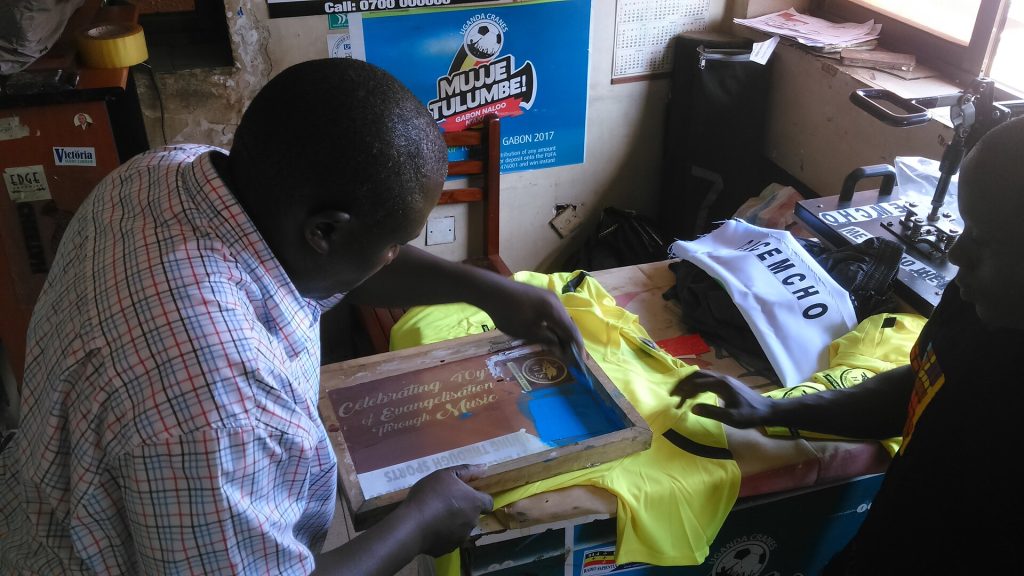
Screen printing pushes thick ink through a mesh stencil with a squeegee. One screen per colour. The ink sits on top of the fabric and gets cured with heat.
DTF (direct to film) prints your design onto a plastic film, dusts it with adhesive powder, then presses the film onto the shirt at high temperature. The film peels away and the design stays.
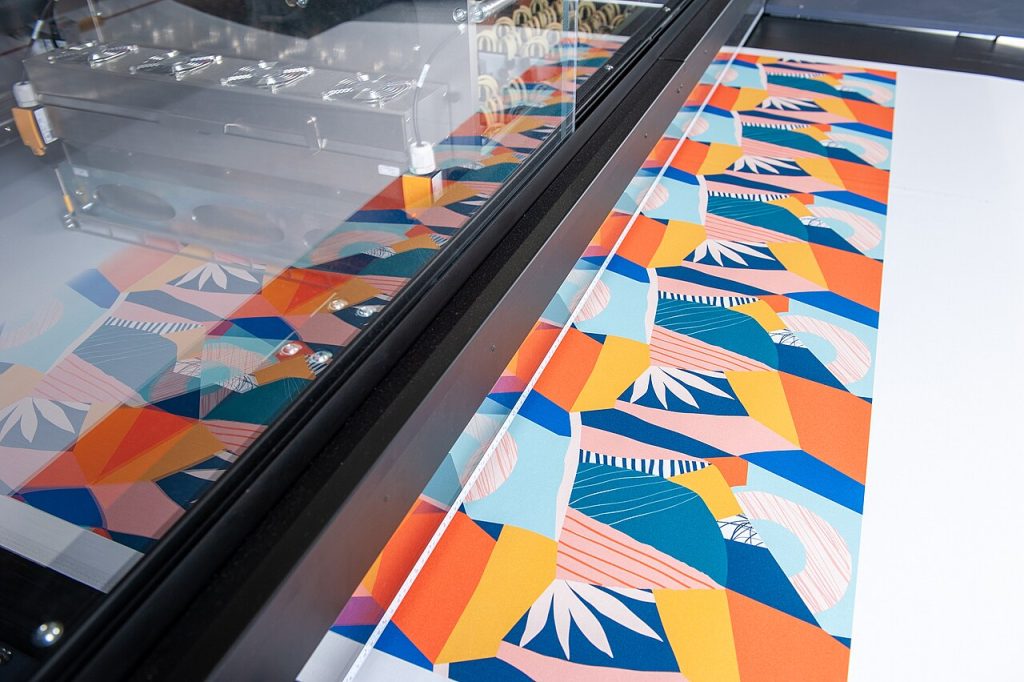
Sublimation prints the design in reverse onto paper, then heat-presses it against polyester fabric. The solid dye turns into gas and bonds inside the fibre itself.
That last one is the odd one out. Screen printing and DTF put something on the shirt. Sublimation changes the shirt.
Here’s the comparison in one line each. Screen printing is cheapest at volume on cotton. DTF is the flexible one, any quantity and any colour, dark shirts included. Sublimation only works on polyester, but it gives you a print that cannot crack, because there is nothing sitting on the surface to crack.
I learned that difference the annoying way. Years ago I promised a client a “print that lasts as long as the shirt”. We sublimated onto cotton because the artwork looked great and the deadline was tight. The shirts came out with a washed-out ghost of the design, about 60% of the colour we wanted, and nothing we did afterwards brought it back. That’s not a printer being careless. That’s the wrong chemistry for the fabric.
So before you fall in love with a method, check three things: how many pieces, what the shirt is made of, and whether the design has photographs or gradients in it. Those three answers eliminate one or two of the options immediately, which is honestly the whole decision.
The rest of this article is the detail behind that. I’ll go method by method, then show you where they overlap and where they don’t.
One more thing worth knowing, because it explains a lot of quotes that look random. The three methods need completely different equipment. Screen printing needs a press, a screen for every colour, an exposure unit and a dryer. DTF needs a specialised printer, film and a heat press. Sublimation needs a sublimation printer, transfer paper and a heat press that runs hot. That’s why one shop quotes three prices and another only offers one method, and why the cheapest quote sometimes can’t actually do the job you described.
If you’re holding a shirt right now and wondering how it was made, look at the inside. Screen print has a slightly stiff patch with the design in the same colour on the reverse. DTF shows a faint film edge if you stretch the fabric. Sublimation shows nothing at all, because the colour is inside the fibre.
Screen Printing — Still the Cheapest Way to Print 100 Shirts
If you’re ordering staff uniforms for a supermarket chain, stop reading and go screen printing. Nothing else gets close on price per shirt at that volume.
The reason is boring and mechanical. Every colour in your logo needs its own screen, its own film, its own registration on the press. That preparation is a fixed cost. It costs roughly the same whether you print 40 shirts or 400.
So the more shirts you print, the thinner that setup cost gets spread. That’s why the quote for 100 always surprises people in a good way, and the quote for 25 always surprises them badly.
A few things I wish more customers knew before they order.
Mesh count decides how much ink lands on the fabric. A coarser mesh, around 110 to 130 threads per inch, lays down a thick opaque layer that’s great on dark cotton. A finer mesh, 155 to 200, gives softer detail for fine lines and halftones, but the print feels thinner and you need a better screen to hold the detail.
Plastisol ink is the workhorse. Thick, opaque, sits proudly on the shirt, and it’s forgiving to print. Water-based ink sinks into the fabric and feels like almost nothing, which is lovely on a 180gsm tee and disappointing on a cheap thin shirt, where it fades faster than you’d like. Neither is “better”. They’re different products for different jobs.
Dark shirts need a white underbase before your colour goes down. That’s an extra screen and an extra pass through the press, so “just print white on black” always costs more than people expect. It also adds a little thickness, which is the trade-off for colour that pops.
Curing is where cheap shops cut corners. Plastisol needs to reach roughly 160°C through the ink layer, usually in a conveyor dryer, and stay there long enough to fully fuse. Skip that and the print cracks after five washes. Not because screen printing failed, but because the cure did. You cannot see a bad cure on day one. You see it in month three.
Screen printing also has a look that people recognise without knowing why. Solid, slightly raised, saturated colour on cotton. If that’s the finish you want on a uniform, no other method gets there.
And here’s when it stops making sense. Small runs, where the setup eats the order. Gradients and photographs, which need halftones and four-colour process work that most small shops won’t price kindly. Anything past four colours, where each extra screen adds money and a chance of misregistration. At that point DTF will beat you on both price and turnaround.
DTF Printing — The Method That Made Small Runs Possible
This is the one that changed the conversation in Nairobi print shops over the last few years.
DTF has no screens and no setup, so there’s no minimum worth mentioning. One shirt is a valid order. Five hundred is a valid order. The price per piece barely moves, because there’s nothing to amortise.
It prints full colour without complaining. A photograph, a gradient, twelve colours in a logo, it doesn’t matter. Colour count is irrelevant to DTF, which is a sentence that makes screen printers wince.
Fabric is flexible too. Cotton, polyester, blends, dark shirts, light shirts. Unlike sublimation, it doesn’t care what the shirt is made of, and unlike screen printing it doesn’t need a white underbase to print on black.
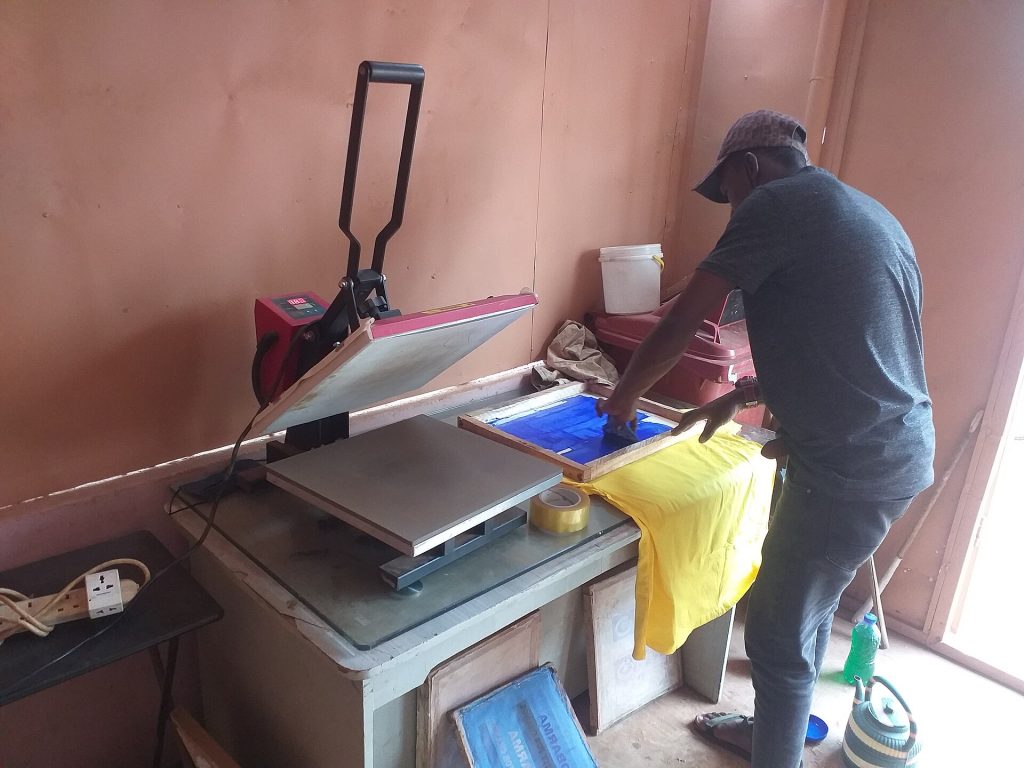
Now the honest part, because I’d rather you heard it from me. A DTF print has a slight hand feel when it’s fresh, a thin plastic layer you can feel with your thumb. It softens after the first wash and most people stop noticing. But if you’re printing a photo across the whole back of a shirt, you will feel it more than a screen print. That’s the trade for full colour at low quantity.
Press settings matter more than suppliers admit. Roughly 150 to 160°C for 10 to 15 seconds, with real pressure. Under-pressure and the edges lift within a week. Over-press and the film scorches, goes shiny, and looks cheap before it’s even washed.
The failure mode I see most often isn’t the method. It’s cheap film and adhesive powder that wasn’t fully melted. Those prints peel at the corners within a month, and then the whole method gets blamed by someone who never saw the good version.
Good DTF survives normal washing for a long time. A year of weekly washes is realistic, maybe longer if it’s washed cold and inside out. It’s not indestructible, but it’s not the fragile thing people warn you about either.
One practical note on volume. DTF is printed as a sheet of transfers and then pressed one shirt at a time, so a 300-piece order takes longer on the press than the same order screen printed. It’s still often cheaper at that quantity if the design is complex, but “no minimum” doesn’t mean “instant”. Ask about turnaround before you promise a client a date.
Sublimation — All-Over Prints, But Only on Polyester
Sublimation is the prettiest of the three and the least forgiving.
The chemistry is genuinely different. You print the design in reverse onto transfer paper with sublimation ink, then press it against the fabric at around 190 to 200°C for 40 to 60 seconds. The solid dye turns into gas and bonds into the polyester fibre. Nothing sits on the surface, so nothing can crack or peel, and the print has no hand feel at all.
That’s also why it only works on polyester. The dye needs a polymer to bond with. On 100% cotton there’s nothing for it to grab, and you get a faint ghost of your design and a wasted shirt. Aim for 100% polyester, or at least a high-poly blend, and check the label before you buy the blanks.
The white ink problem catches everyone, including me. Sublimation has no white ink. White is the paper showing through. So you cannot print white text onto a coloured polyester shirt, and you cannot print a light design on a dark garment. The design has to work with the garment colour, or the garment has to be white.
Where it wins is anything that needs colour everywhere. Sports kits with a pattern running across the whole jersey, through the sleeves and over the seams. All-over prints where the design is the fabric. Mugs, flasks, mouse pads and anything with a poly coating, because the coating is what the dye grabs.
The Kenyan sun is the catch nobody mentions. Sublimated polyester prints do fade, and they fade faster in a car window or on a clothesline at midday. Store them inside out, dry them in shade, and a jersey looks sharp for years. Leave it in the sun every week and you’ll see it go soft by the second season. I’ve seen a club’s away kit go from bright yellow to a pale butter colour in about eighteen months because it lived on a washing line.
There’s also a fabrication detail people forget. Sublimation is usually done on the cut panels before stitching, so the pattern can run continuously across seams. That’s why a sublimated jersey looks designed rather than decorated. It also means you can’t change the design after the panels are printed, so approve the mock-up carefully. Really carefully.
What Actually Drives the Price in Kenya
People ask for a price per shirt, and I always want to ask three questions back.
First, what’s the garment? A basic cotton tee and a heavyweight 180gsm tee are different products, and on small orders the shirt is often the bigger half of the bill. Cheap shirt plus expensive print is still a cheap shirt.
Second, how many colours, or how much area? Screen printing charges by colour, because each one is a screen. DTF charges by printed area, because the film is priced by size. A small chest logo and a full back print are not the same job, even though they’re the same shirt. Sublimation charges by garment, because the print is the garment.
Third, how many pieces? Quantity breaks are real, and they’re not linear. Going from 20 to 50 changes the price per shirt a lot. Going from 50 to 100 changes it less. Going from 100 to 150 sometimes barely registers, because the setup was already paid for.
Artwork is the quiet one. A vector logo costs nothing to print properly. A photograph of a logo taken on a phone needs redrawing first, and that’s a design charge, not a printing charge. Expect that conversation to happen before any press starts.
Turnaround matters too. A standard order moves through a queue. A rush order jumps it, and that costs more than most people assume. It’s not greed, it’s the reality of a press that’s already booked and a team that has to stay late.
Sizes are worth mentioning while we’re here. A run of smalls and mediums and a run that includes 3XL are different jobs, because garment cost climbs at the extremes and some blanks don’t exist above 2XL. If your team has one person who needs a 4XL, say it at quoting stage rather than after the shirts arrive.
Fabric weight is the other hidden multiplier. A 140gsm tee feels like a give-away shirt and honestly it prints fine, but it will not survive a year of weekly washing the way a 180gsm or 200gsm tee will. On uniforms, that difference is usually worth more than the ink.
There’s a materials angle too, and it’s specific to Kenya. Blanks are often imported, so the price of a good 180gsm tee moves with shipping and duty, not just with the printer’s mood. Inks and film are imported as well. That’s why a quote given in January and a quote given in June for the same job can differ even when nothing about your order changed.
So skip the per-shirt guess. Send the quantity, the shirt type, the sizes and the artwork. One number back beats five estimates, and it’s the only number that means anything.
Which Method Should You Choose? A Quick Decision Table
| Your situation | Method | Why |
|---|---|---|
| 50+ shirts, 1 to 4 colours, cotton | Screen printing | Cheapest per piece, best value at volume |
| 1 to 50 shirts | DTF | No setup, full colour, any fabric |
| Full-colour photo or gradient | DTF | Screen can’t do it economically |
| Dark shirts with light artwork | DTF, or screen with an underbase | Both work, compare the two quotes |
| Sports kit or all-over pattern | Sublimation | Polyester only, print goes into the fibre |
| Mugs, flasks, mouse pads | Sublimation | Needs poly-coated blanks |
| 100% cotton, full-colour print | DTF | Sublimation won’t bond to cotton |
| Church or school event, 200 shirts, 2 colours | Screen printing | Volume plus simple artwork |
Three briefs cover most of it.
Staff uniforms, 60 pieces, two colours. Screen printing, no contest. The logo is simple, the quantity is decent and the shirt is cotton.
Event merch, 30 pieces, a logo with a gradient. DTF, because four screens for thirty shirts would cost more than the shirts themselves.
A football team, 18 jerseys, pattern across the whole shirt. Sublimation, and the shirts must be polyester. If someone quotes you sublimation on cotton jerseys, walk away politely.
Sometimes both quotes come back and both are fine. That’s when you choose on feel rather than price. Screen if you want the print to sit proud and last forever. DTF if you want soft, quick and flexible on quantity.
And there’s a hybrid answer for mixed orders. Polo shirts for management, screen printed if the numbers justify it, and a handful of sample shirts in DTF for the photo-heavy design. Nobody says every item in one order has to use the same method, though it’s usually cheaper when they do.
Two more situations come up constantly. A funeral committee ordering 40 shirts with a portrait on the back: that’s DTF, every time, because a photograph on 40 shirts is not a screen printing job and the deadline is usually short. A school ordering 300 shirts with the crest in two colours: that’s screen printing, and the crest should be supplied as a vector so nobody redraws it under pressure.
If you’re stuck between two quotes, ask one question: what happens if a shirt fails? A printer who says “bring it back” is telling you they control the process. A printer who blames the fabric is telling you something else.
And if the order matters, ask for one sample shirt first. Pay for it if you have to. Washing that single shirt twice tells you more about the next 300 than any sample photo will.
Making the Print Last — Wash and Care Advice
You can print perfectly and still ruin it in the laundry. I’ve seen it happen with all three methods, and it’s always the same conversation afterwards.
Wash inside out, cold, on a normal cycle. Hot water and agitation are what kill prints, not the ink itself. Thirty degrees is plenty for a printed shirt.
No bleach, and no tumble dryer if you can help it. Heat is the enemy of anything plastic-based, and DTF is plastic-based by design. If you must tumble dry, use the lowest setting and take it out slightly damp.
Never iron directly over a print. If a shirt needs pressing, put baking paper over the design, use the lowest setting, or iron the inside. A hot iron on a DTF print will leave a shiny patch that never comes out.
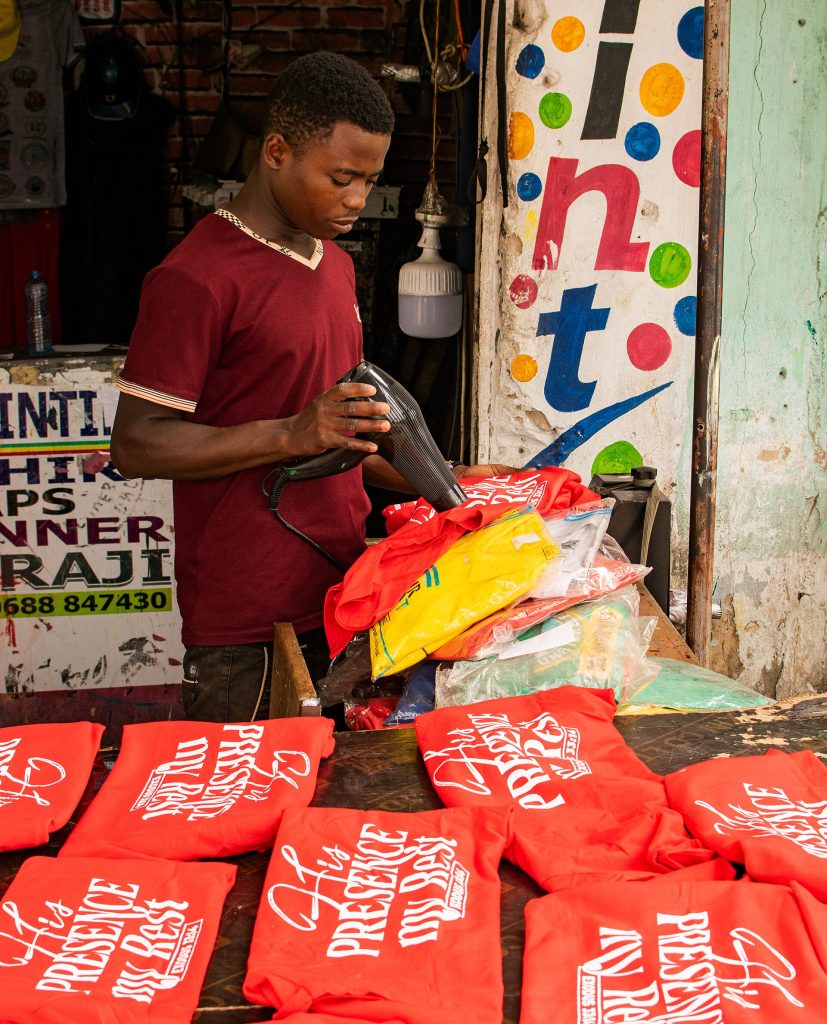
Dry in the shade. This matters most for sublimated polyester, where the Kenyan sun does its damage. A shaded line extends the life of a jersey by years, and it costs nothing.
Store shirts folded rather than on hangers for long periods, especially heavy prints. Hanging stretches the shoulder and pulls at the print over time.
Stains are worth a word. If ink or paint gets onto a printed area, don’t scrub it. Scrubbing lifts the edge of a DTF film faster than anything else, and once a corner lifts it will not go back down. Blot it, wash cold, accept the mark.
And if a print cracks at six months, don’t blame the method. Cracking is almost always under-cured ink or under-pressed film. It’s a process failure, and it’s fixable at the printing stage, not the washing stage. A good printer will ask you what happened, not argue.
There’s a test you can run before you commit to a big order. Take one sample shirt, wash it three times the way your staff actually will, and look at it in daylight. If the print still looks solid and the edges are still sharp, the process is right. If it has gone chalky or the corners have lifted, you’ve just saved yourself the cost of the full run.
For polyesters, that test matters double. Sublimated prints look magnificent on day one and honest after ten washes. Check before you print a whole season of kit.
Conclusion
Here’s the whole thing in one breath. Screen printing is the volume play on cotton. DTF is the flexible one that handles any quantity, any colour and any fabric. Sublimation is the specialist, perfect on polyester and useless on cotton.
The decision rule is simple. Quantity decides between screen and DTF. Fabric decides whether sublimation is even on the table.
If you’re still unsure, don’t guess. Send three things, how many shirts, what the shirt is made of, and your artwork, and you’ll get a straight answer and one price. Even if that answer is “you don’t need the expensive option”.
Cost decides it as often as the fabric does, so the printing price list has the starting price for every garment and decoration method here.
Ready to print? See our t-shirt printing services in Kenya or send your quantity and artwork for a quote.